Originally published in Pharmacopeia Obscura: The August Doctor’s Notes
Orchard of the Cenobites
A faithful votary harvesting medicine from sacred orchards discovers the price of salvation is far worse than imagined.
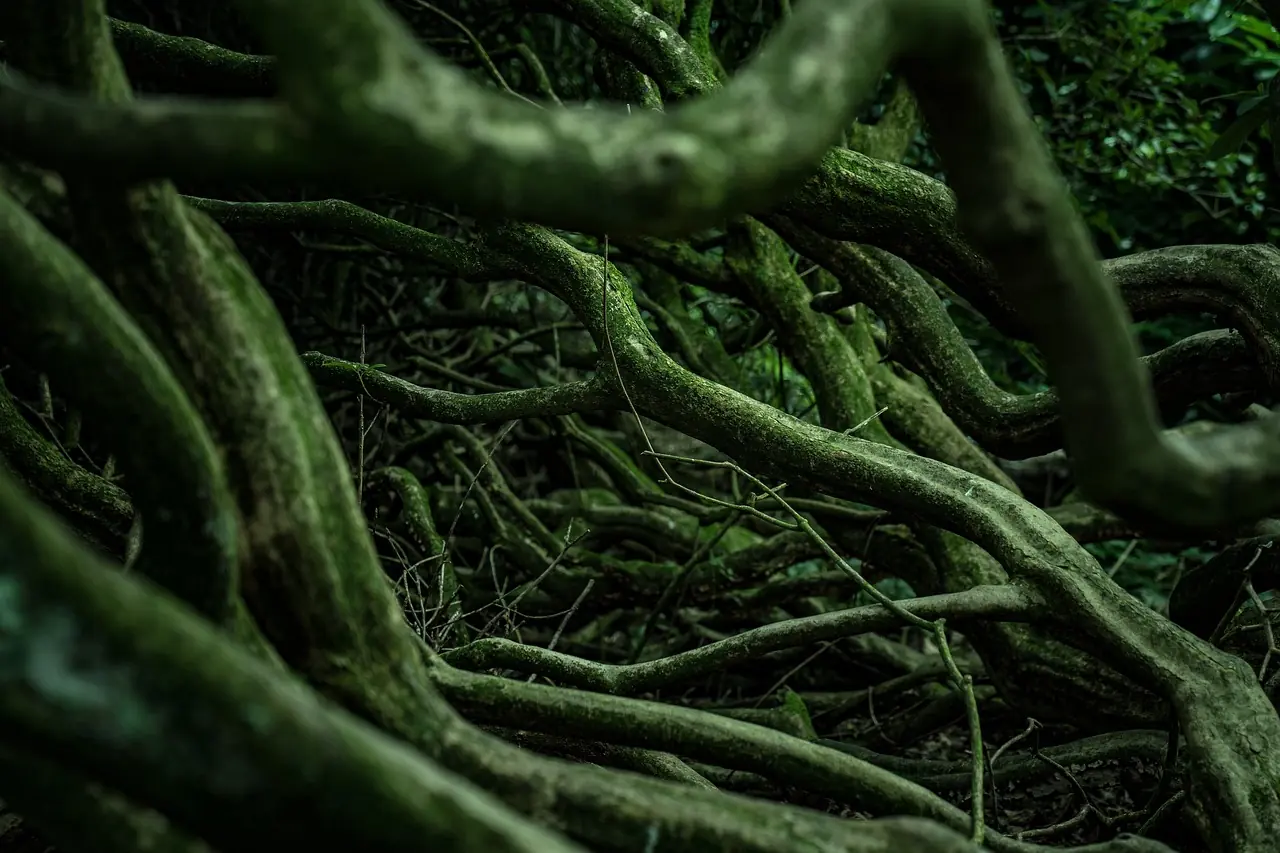
The eyes of the penitent gazed skyward, blind and unblinking beneath a faint layer of dust and detritus fallen from the branches of the blackwood tree overhead. Bound and bonded to the tree in the embrace of the vines of redemption, the body had long since been penetrated and infiltrated in near totality: Thick lengths of the vines had pried the jaws apart into a mute howl and gone questing down the esophagus. Fine tendrils, visible just beneath the surface of the skin, laced together in a simulacrum of blood vessels that preserved the flesh and transmuted the sin of one into the salvation of many.
As was the custom of the arborists of her order, Marilusa averted her gaze from the penitent as she set her ladder up against the trunk of the blackwood. Despite the length of her robes, she clambered up the rungs and into the boughs of the tree with simian ease. The blackwood grew no leaves—that was the purview of the symbiotic redeemer vines, wound in thick gray coils around the trunk and bristling with waxy red leaves shaped like small coins. What the blackwood did have in abundance, however, were flowers. Canary yellow blossoms the size of a pebble, flyspecked with spots the color of dried blood. The bloomage stood in stark contrast against the thick, ebon bark of the tree with its deep fissures revealing living wood the color of viscera beneath.
Marilusa shrugged off the broad basket slung over her shoulders before going to work with her small knife, cutting the flowers at the stem and transferring them to her basket. The flowers were as innumerable as grains of sand on the shore, but she worked with practiced efficiency in systematically denuding each of the branches. It was exhausting work, requiring many trips up and down the ladder to deposit the contents of the basket into the waiting cart below, but she was well-accustomed to the labor by this point in her spiritual journey. Her body was lean and wiry, her hands and feet calloused from scraping against the rough bark of the blackwood trees day in, day out, for years on end.
A sudden tremor in her hand caught Marilusa unaware, her knife slipping from her grasp to dangle from the rope knotted to the sash of her robe. She swore softly to herself and put the back of her hand to her forehead. Her skin was cold and clammy to the touch, and, now that she cared to think of it, there was a malign thread of nausea weaving through her stomach. The trembling sickness was upon her, of that there could be no doubt.
Marilusa slackened her pace, taking care to treat the harvest of the flowers with due and proper reverence while at the same time doing her utmost to steady the shaking of her fingers. Her traversals up and down the tree were more deliberate, taking the time to ensure that she had solid hand- and footholds so that the fleeting spasms in her limbs would not dislodge her grip and send her tumbling to the ground. After the sun had set, she continued to work by the ambient light of twilight to gather the blossoms; she had not failed to fully harvest a tree in a single day since early in her apprenticeship, when she was still soft and coddled.
“Sister Marilusa?” a robed man called from below. Marilusa peered down through the branches stripped naked by her efforts to see another robed figure pulling a cart of the yellow flowers, holding a lantern aloft. “Marilusa, are you still up there?”
“Brother Fyne, is that you?” Marilusa called back in response.
“It is,” Fyne confirmed. “Were you planning on staying up there all night?”
“I was just finishing for the day,” Marilusa sighed as she gingerly climbed back down to earth before hooking the ladder to the side of her own cart. She could not help but note that the results of her compatriot’s harvest dwarfed her own. Given the way Fyne’s gaze lingered on her cart, it seemed that he could not either.
“The trembling sickness,” was all Marilusa offered by way of explanation.
Fyne sucked his teeth for an instant. “You need to add more medicine to your tea? Already?”
Marilusa only nodded in the gathering gloom as she pulled her cart forward.
“An insidious disease,” Fyne said as they left their row of the orchard to join the other arborists pulling their hauls of flowers toward the towering chimneys of the drying kilns in the distance. “The more we fight it, the stronger it becomes.”
“I am not so far gone,” Marilusa protested, even as sweat trickled down her brow and her knees quivered from the effort of pulling the cart. “I am not one of those grayhairs drinking tea at all hours of the day when it no longer even keeps the pain at bay.”
“No, but you may be one day,” Fyne said quietly. “Even if you avoid plague and murder and accident and injury, the trembling sickness awaits us all in the end. There is no circumventing it, I fear. And, to speak of my fears, people seem to be reaching the point where the sickness cannot be fended off any longer earlier and earlier with each passing year.”
“Hence we are put upon to harvest the blackwood flowers,” Marilusa said.
“Hm,” Fyne grunted, a frown creasing the corners of his face. “Mari, I tell you this in confidence, but it is something that has been weighing greatly upon my mind. I do not believe the math works out.”
“What math might that be?” Marilusa panted.
“I pray, consider,” Fyne said in hushed tones. “Every year, the population of the city swells, and the strength of the trembling sickness grows. It takes years for a whitewood clipping to reach maturity and be grafted with the vines of redemption, and then further years still for it to develop into a proper blackwood so that a penitent can be given over to it. The Moral Imperative has expanded sentencing for what crimes merit sending someone to the orchards, but the true limiting factor is not the number of sacrifices, it is the number of trees. We can only take so many clippings from the Motherwood and keep it healthy, after all. Some have suggested that we preserve some of the whitewoods to create new Motherwood trees—that is a fraught point of theology in its own right—but they are not taking into consideration the length of time it would take for any new tree to reach a viable size that we could start taking clippings from it.”
Marilusa’s head swam as the weight of her cart seemed to increase despite the lack of any additional load being added to her burden. “Speak plainly,” she complained. “I cannot follow your thoughts when you speak at such speed.”
“Mari, what I mean is that we are in a battle of attrition with the trembling sickness, and I fear that we are losing. It will not be immediate—it will not even be soon, I think. I would guess we have maybe a generation before the balance tips. Perhaps a bit longer, allowing for war and famine to thin numbers. Make no mistake, though, the people’s need will eventually outstrip our ability to supply relief, and then . . .”
“And then what?”
Fyne shrugged. “Prophecy is the remit of oracles,” he said. “But I think that when there is not enough medicine for all, there will be an inevitable division where some people are deemed worthy of receiving it and others are not. It will lead to great unrest, of that I am certain. People may even turn against the order, who is to know? We should give thanks to the Almighty that it is unlikely we will be here to witness it.”
Without a further word, Fyne increased his pace, making it apparent that he had only tarried for Marilusa’s benefit as he quickly left her behind. Even those arborists who had been assigned trees far further out in the orchards than she were passing her by at a steady pace. Ultimately, she was last to arrive at the kilns, sweating and shaking and on the verge of vomiting. The kiln tenders took mercy upon her, sending her on her way back to her chambers while they went about the task of unloading the pile of flowers to be added to the rest of the day’s harvest, heaped high and waiting to be dried in the enormous clay ovens before being sent to the great milling houses to be ground into life-saving medication.
Marilusa practically fell through the door of her monastic cell, and with trembling hands splashed nearly as much water out of the cistern as she managed to get into her kettle. Shivering on her stool, she rocked back and forth as she waited for the hearth fire to heat the water. Summoning a reserve of strength she had not previously known herself to possess, she managed to pour the steaming water over the tea leaves in her clay mug without spilling too much before fetching the canister of medicine from the shelf. She placed two heaping spoonfuls of the white powder into the water and stirred vigorously, aided in part by the shaking of her hand. No sooner had the drug dissolved than she put the bitter liquid to her lips and sipped gingerly, keenly intent on ingesting the medicine as quickly as possible rather than wait for the tea to cool.
She sighed as the blessed relief swept through her veins moments later. Collapsing onto her straw mattress, she fell into a deep and dreamless sleep as oblivion claimed her.
The next morning, Marilusa rose before the sun, donning her black woolen robes as soon as there was enough light for her to discern the contents of her cell without the aid of her oil lamp. Bound and determined, she resolved to finish collecting the flowers of not just the tree she had left incomplete the previous day, but another one besides. There was no expectation that she should do this—all were ailed by the trembling sickness at some point or another—but it was a point of pride for her to not allow the disease to prevent her from completing her duties.
The air was chill as Marilusa stepped onto the thoroughfare of packed earth that led into the heart of the blackwood orchards, pulling her cart loaded with her ladder and basket behind her. Coming in the opposite direction was a train of perhaps a dozen people shackled together in a line, being ushered to the monastery by a quartet of black-clad officers of the Moral Imperative with their silver helms and long quarterstaffs. It was not taboo for the arborists of the order to witness the arrival of penitents from the city when the Moral Imperative brought them to be given to the trees, but transferring them to the detainment chambers where they would be sanctified and prepared for the blackwood was still something that the authorities preferred to be conducted at an early hour with as few witnesses as possible.
This was not the first time that Marilusa had witnessed such a transfer and she thought nothing of it until one of the penitents lurched out of line as she passed, toppling to the earth and clawing at her robe. She screamed as the man looked up at her with hollow cheeks and a frantic expression.
“Mari!” the man cried, clutching at her robes even as one of the Moral Imperative officers bludgeoned him and demanded that he get back in line. “Mari, you must help me!”
“Almighty save me, Tirus?” Mari asked as her eyes grew wide. She had not seen Tirus since she had spoken her devotion to the order more than a decade ago. But even though his features were more worn than she remembered, there could be no mistaking her brother.
“Mari, you have to tell them!” he shrieked as the first officer was joined by another to seize Tirus beneath each arm and haul him back to his feet. “It was only a mistake in my ledgers! An accounting error! I can pay the difference, with interest! Mari!”
Now there were three officers bodily dragging Tirus along with the other prisoners, even as he howled Marilusa’s name and grabbed nothing but air in the growing distance between them. The fourth officer lingered nearby, eyeing Tirus with a sidelong glance.
“Are you all right, Sister?” the officer asked quietly.
“What?” asked a dazed Marilusa. “Yes, I am . . . unharmed.”
“You know that one?”
“In a different life,” Marilusa said as the line of prisoners passed through the gates of the monastery. “What he said—did he—what was his crime?”
The officer harrumphed and leaned his weight on his quarterstaff. “Failure to render taxes due.”
“Taxes?” Marilusa repeated, frank disbelief creeping in around the margins of her voice. “We are consigning people to be bound to the blackwood for failure to pay taxes, now?”
The officer’s eyes shot from the distant prisoners over in Marilusa’s direction, a hard expression falling across his face. “The Moral Imperative is tasked with upholding the rectitude of the city,” he said, his words weighted with authority. “If we determine that the righteousness of our citizens is in decline, then it is incumbent upon us to correct that failing. For too long, people have imagined that they can commit as much sin as they wish, so long as it did not exceed some imaginary threshold they held in their minds. We aim to disabuse people of that notion going forward.”
“Of course,” Marilusa said. “I understand completely.”
The officer’s demeanor lightened as he barked a laugh. “If you did not, I hardly imagine you would be trusted with your sacred task.” He nodded his head in her direction as he started to walk away toward the monastery. “Good day, Sister.”
“Good day to you as well, officer.”
All day, the anxiety in Marilusa’s gut flailed like a viper tied into a knot and lashing out with venomed fangs. Rather than working the remainder of the previous tree and a second tree for the new day, if anything the speed and quality of her work flagged even further. Her hands shook, her limbs quavered, and she was so nauseated that she wanted to bend over double and empty her breakfast onto the soil. She knew full well, though, that this was not the trembling sickness that held her in its grasp.
Marilusa had never been particularly close to Tirus. Though he was only ten years her senior, in her mind he had always been an adult—or near enough not to matter to a small child. Indeed, he had started his own household years before she had taken her vows of devotion, seeing her only a few times a year when he came by to visit with the family and stay up late speaking of the matters of men with their father. But she had always known him to be a good, honest man. If there was some discrepancy in the tallies of his accounts against what he owed the state, she had no doubt that it was one born of accident rather than malfeasance or even neglect. To be deemed a penitent for so trivial a trespass seemed unthinkable.
This was not the mission to which Marilusa had devoted her life. The blackwoods were for the redemption of the worst of humanity, not capital punishment to be doled out for petty offenses. How would the Almighty sit in judgement of her soul if she condemned her own brother to an unjust fate through inaction?
Marilusa had no idea how she could possibly save Tirus, but there was no doubt in her mind that she would never be able to live with herself again if she did not at least try.
The obstacles to freeing Tirus were immediately obvious and of great number. Trying to free him from the detention chambers beneath the monastery was out of the question: that was the exclusive domain of the Moral Imperative. No arborist would have any reason to be down there, so there would be no ready excuse to explain Marilusa’s presence. Even if she were to somehow gain access to the detention area and successfully extract Tirus, they would still need to get through the rest of the monastery complex and out the gates unobserved. An utterly impossible task.
No, she would need to wait until they moved him outside. Which meant she would need to wait until they bound him to a virgin blackwood.
That presented its own set of problems. Marilusa knew where the trees awaiting the sacrifice of the penitents were, but not the timing. The penitent would need to be bound to the redeemer vines while the blackwood was in its first bloom, readily identified by the presence of white blossoms before the rite of redemption changed them to the more familiar speckled yellow petals. But the orchards were vast, and the virgin trees were nowhere near where she could plausibly find herself during the day’s harvest. There could be no reconnoitering while the sun stood in the sky.
Marilusa’s time was her own once the sun had set, however, and it was not unusual for arborists to walk the monastery grounds and the orchards at night. The real difficulty was the distance, for the trees she sought were at the very furthest fringes of the orchards. It would be a long trek out that far and back, and the hour would be late upon her return. That would certainly give rise to someone’s notice, but it remained the only hope for finding Tirus and could not be helped.
And so Marilusa began nightly pilgrimages to the distant trees, doing her best to keep a mental map of which trees had already started to sprout the buds of flowers and trying to ascertain how far along they might be. Each night she returned to her austere cell, bone tired with barely the strength to brew enough tea to keep the trembling sickness in check before falling onto her straw mattress for a few hours’ worth of sleep, only to rise with the sun to spend another day at hard labor.
For more than a week, this continued. There were just so, so many trees. Marilusa could not possibly survey them all in a single night, even if she forwent trying to return before the dawn. It was not until the ninth night that she found the first of the penitents, dressed in the white sacrificial robes and bound with hempen rope to one of the trees. The silken flowers were slowly unfurling in the light of the moon, so it could not have been more than a day since the penitent had been tied, but already the tendrils of the redeemer vines were knitting a network of runners across the chest. The shorn head lolled forward at the neck, hiding the face and making it impossible to discern whether this was Tirus or another of the dozen condemned souls. Weighing the risk, Marilusa raised the shutter on her bullseye lantern to shine light upon the captive.
At the sudden light, the prisoner raised his head. A stranger stared back at Marilusa, his mouth agape. “Help!” he said in a hoarse whisper, straining against his bonds. “For the love of the Almighty, please help me!”
Marilusa steadied her hand so that the light would stop quaking. “Do you know where Tirus is?” she asked, her voice far more steady than she felt inside. “The one who grabbed at me on the way into the compound?”
“What? No, how am I to know that?” the man hissed. “They separated us upon arrival, I have seen no one but the Moral Imperative for the past week. I beg you, the Almighty would not have set me in your path if he did not intend for you to free me! I shorted a sack of grain I sold, for that I am to be lashed to the blackwood? Your mercy, I beseech you!”
“No, I cannot, I—I will come back for you,” Marilusa pledged as she dropped the shutter on her lantern. The penitent only responded with a low moan. “I need to find my brother first. There will only be one opportunity to flee, and I cannot leave without him.”
“No! Please, do not leave me to this!” the man cried as Marilusa turned away in the darkness. “Cut me free! Even if I am captured, I know not who you are, there would be nothing linking us! Please! Please!”
Marilusa bowed her head and closed her eyes against her tears as she walked on.
Marilusa found another two penitents tied to blackwoods the following night, and a third two nights after that. Each scene played out much as it had with the first, but she noted with alarm that with each passing night the vines further seemed to be wrapped tighter around their offerings, the runners climbing up their necks as though in search of orifices to penetrate. By the time she had found the third penitent, even if she had cut away the ropes, it would not have been enough. The vines held the woman in their embrace and would not let go. Still, to each she promised that she would return once she had found her brother so that they might all seek safety away from the malevolent orchards together.
Marilusa finally found Tirus, a full fortnight after she had begun her search. She fell to her knees and wept to behold him, both from the weariness of her weeks of exertion in her hunt for him, and from the extent to which the vines had already taken him. His eyes were closed, his shaved head rolled back, and even in the moonlight Marilusa could make out where the fibers of the plant had worked their way beneath his skin and begun tunneling into the muscle and sinew.
The flowers, though, were still white. So long as they had not begun the change, there was still hope.
“Tirus!” Marilusa said, standing to her feet once more. She seized one of the vines in her grasp and pulled as hard as she could, but it held fast. Instead, the small red leaves seemed to rustle in response, and the thick vine contracted beneath her grasp.
Tirus’s eyes opened as he moaned in pain, the subcutaneous tendrils visibly twisting and turning in the light of the lantern. “Mari?” he croaked.
“Hold still,” Marilusa said, brandishing her ceremonial knife. “I will cut you loose.”
“Please,” Tirus said, his eyes closed as his head rolled back once more. “Please, free me.”
Marilusa hacked away at the vines, sobbing at the lack of progress she was making. Her knife was well and fine for cutting the stems of flowers, but was too short and too dull to cut through the thick, woody vines. They bled a sticky sap, black as pitch, that gummed up the edge of the knife and made it even less effective. Tirus could do nothing but groan in pain, for her frantic attempts at pruning as the penetrating creepers only seemed to curl inward and dig deeper.
“Free me,” was all Tirus said, repeated over and over like a mantra until it lost all meaning in Marilusa’s ears.
There was the clatter of a lantern shutter being drawn, and a new light fell across Marilusa, Tirus, and the tree. Marilusa wheeled, her small knife held outstretched in threat. Even with the brightness of the light in her eyes, she could make out the forms of the Moral Imperative officers behind the lantern from the silhouettes of their quarterstaffs.
“That is enough of that, Sister,” said the officer holding the lantern.
“How . . . how did you find me?” Marilusa asked.
“You have made quite a number of promises to some of the penitents,” the voice said coolly. “Some of them volunteered information in the hope that their sentence would be commuted. Clearly, they wagered that it was better odds than you ever returning to fulfill your vow.”
“Free me,” Tirus whispered, reclaiming Marilusa’s attention. She turned and met his glazed and unseeing eyes. “Free me.”
“And did you release them?” Marilusa asked, turning back to the officers.
“Of course not. But we could not take action based solely on the word of the penitents alone, you see. They have already been judged guilty and are, as such, not credible witnesses. It was necessary to catch you in the act. And here we are. Please drop the knife, Sister.”
“Free me,” Tirus muttered, his strength visibly failing him as Marilusa turned toward him once more.
“Sister? The knife,” commanded the officer.
“Yes,” Marilusa said, reversing her grip on the handle and wiping as much of the sap off on her robe as possible. “The knife.”
With a scream of anguish, she swiped the edge across Tirus’s throat. Whatever its inadequacies that night in cutting through the vines, the blade still parted flesh readily enough. The blood cascaded in a scarlet sheet over Tirus’s chest and the vines of redemption, saturating the soil at his feet. Sobbing, Marilusa dropped the knife and fell to her knees as the white petals of the blackwood drifted down around her like snowfall.
Winter afternoons were the worst. It was not the cold that bothered her—Marilusa no longer experienced such things in the same sense that she once had—but rather it was that the limbs of the blackwood were bare, and there was nothing to stop the sun from shining directly into her eyes—forever open, forever gazing into the heavens—as it rose just above the canopy of the trees into her line of sight. The pain would last for hours, blinding her for still more hours to come, but the damage was never permanent. The preservative nature of the redeemer vines that riddled her flesh and organs in some botanical analog to veins and arteries seemed to prevent that, but did nothing to alleviate the agony experienced each day.
Springtime was more tolerable, as the sun’s transit across the sky rose out of her eyeline and the boughs of the blackwood that filled her view were studded with pale yellow buds that would eventually give bloom to the flowers that were as much hers as the tree’s. She could not help but resent the eventual arrival of summer, when the arborists would come with their carts and their ladders and their baskets and their knives to strip her flowers away from her, leaving her with nothing to look at for the remaining months of the year but the sky as viewed between wracked branches of black bark veined with cracks revealing blood-colored wood beneath.
They had, of course, sentenced her as a penitent to be given over to the trees. Even if the Moral Imperative had not been so inclined to prosecute even the most inconsequential crimes with capital punishment, never in living memory had there been a transgression as severe as her own. Not only had she killed Tirus, but in doing so had despoiled the symbiotic relationship between penitent, redeemer vines, and blackwood that gave rise to the precious flowers. Years of painstaking cultivation ruined, when all the while the trembling sickness’s strength was waxing and the loss of capacity in producing the flowers could be ill-afforded. At the time, she could scarcely disagree with the sentencing herself: if a crime as great as her own did not merit such a sentence, what misdeed possibly could?
But that had been before she fully comprehended the true fate of the penitents. Would people still be sentenced to the trees if those sitting in judgement knew that the act did not just preserve the convicted’s flesh in the vines’ clutches, but their mind as well, holding them entirely conscious in perpetual paralysis? With no way for the penitents to communicate their plight, it was a question that would never be raised.
For decades, she remained part of the tree, far beyond the natural span of her years, the relief of death denied her by the organism that had so utterly corrupted her body as it had the tree’s natural reproductive cycle in order to produce the aberrant blossoms. The fabric of her mind frayed with time and isolation until any memories of an existence prior to this one were faded beyond all recall, leaving her without even language to form her thoughts.
It was not until the scent of smoke reached her, filtered through the years of dirt and debris that filled her nostrils, that her mind stirred to anything near lucidity. She became aware that there were so many people around her, now, Brothers and Sisters of the order being run to ground by shouting mobs who stood over them, assailing them with cudgels and hobnailed boots. Someone splashed a fluid on her face with a scent that was simultaneously intimately familiar and forever lost to her. It was not until someone set light to it with a torch that she recognized the long-forgotten odor of lantern oil.
The pain was excruciating as the fire blackened her flesh and boiled the humor of her eyes. The interwoven tendrils of the vines of redemption, burrowed marrow-deep within her, writhed like a cornered animal lashing out in panic as they, Marilusa, and the blackwood alike were consumed in the conflagration.
Had she breath, she would have screamed.
Had she words, she would have thanked the Almighty.